
Certification Number
004
Category
Category
Location
1753 Shimonumabe, Nakahara Ward, Kawasaki City; NEC Tamagawa Plant
Owner/Administrator
NEC Corporation
Scope and Content
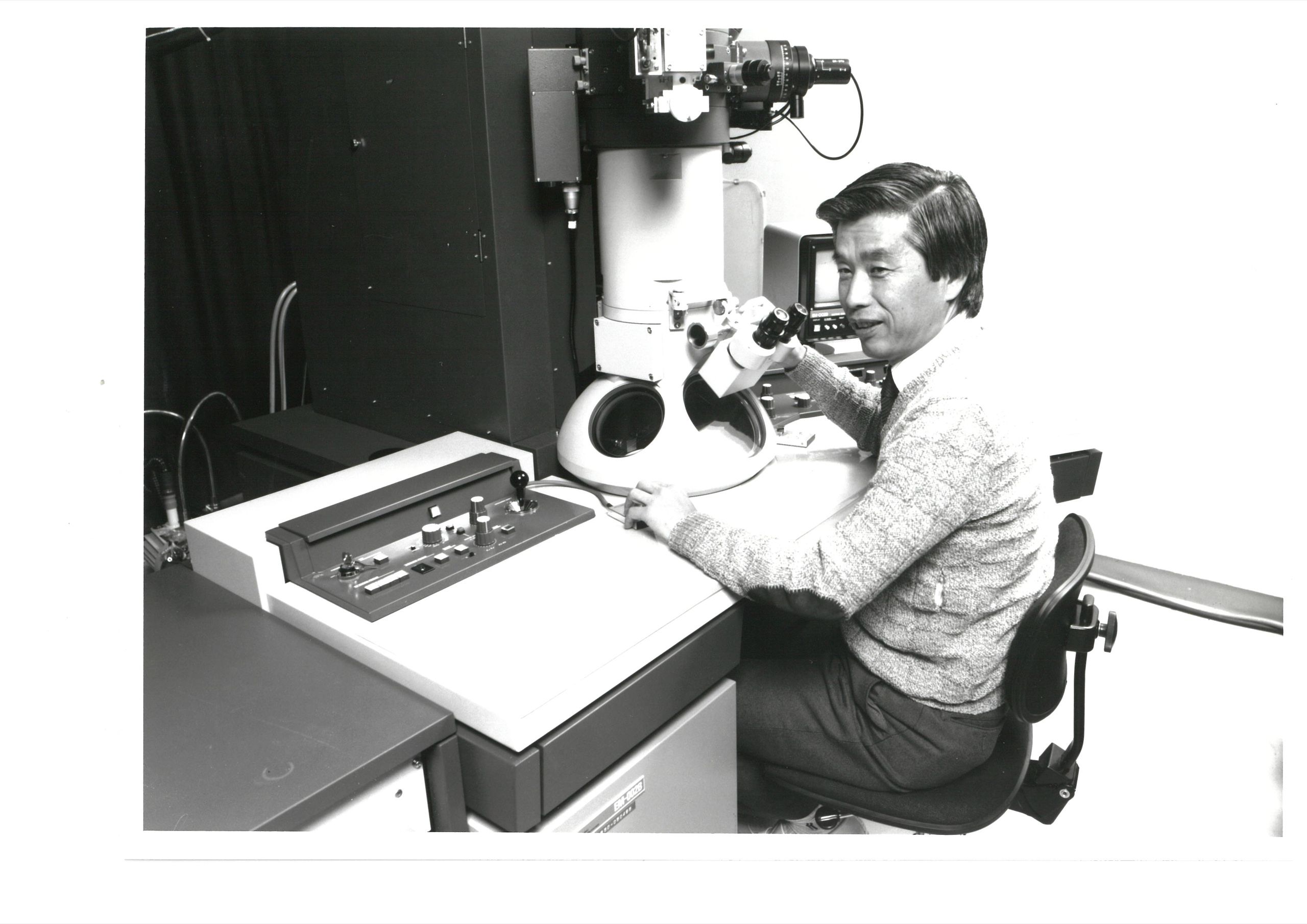
Transmission electron microscope (Topcon EM-002B), accompanying accessories, a model of a carbon nanotube, and the paper describing the discovery of carbon nanotubes
Era
1988 (Installation of an electron microscope)
Designation as Cultural Properties, etc.
None in particular
Reasons for Certification
This instrument is the high-resolution transmission electron microscope used by Sumio Iijima when he made the world’s first discoveries of multi-walled carbon nanotubes in 1991 and single-walled carbon nanotubes in 1993. The discovery of carbon nanotubes led to the subsequent rise of nanoscience and nanotechnology, and as the instrument that marked the beginning of this field, it holds particularly high academic value.
Photographs
Image

Description
Explanation
This item is the high-resolution transmission electron microscope (model Topcon EM-002B) used by Sumio Iijima when he made the world’s first discoveries of multi-walled carbon nanotubes (CNTs) in 1991 and single-walled carbon nanotubes in 1993.At the time, this electron microscope featured an acceleration voltage of 200 kV, enabling ultra-high resolution; it allowed for the imaging of material microstructures and the analysis of crystal structures via electron diffraction, and has contributed to numerous outstanding research achievements since its introduction.It possessed the outstanding characteristic of maintaining a stable electron beam even when switching from observation mode to electron diffraction mode; since it facilitated the observation and structural evaluation of microcrystals in particular, it made significant contributions not only to nanocarbon materials research but also to research and development related to compound semiconductors and high-temperature oxide superconductors at that time.
In 1991, at the NEC Fundamental Research Laboratories (Tsukuba City, Ibaraki Prefecture), Iijima became interested in the deposits on the carbon electrodes used in fullerene synthesis experiments and began observing them using this instrument.In the course of this work, he made the world’s first discovery of carbon nanotubes (CNTs)—previously unknown needle-like and tube-like carbon structures—and succeeded in elucidating their atomic arrangement and multilayered concentric cylindrical structure through analysis of high-resolution electron microscope images and electron diffraction. These findings were published in *Nature* that same year and caused a sensation worldwide.
CNTs are extremely thin one-dimensional structures consisting of a cylindrical tube formed by rolling up a sheet of carbon atoms arranged in a hexagonal pattern. A tube consisting of a single layer of this sheet is called a single-walled CNT; one with two layers is called a double-walled CNT; and those with three or more layers are called multi-walled CNTs. Because they combine exceptional mechanical strength, electrical conductivity, and thermal conductivity, they are the material that sparked the rise of nanoscience and nanotechnology.
This discovery goes beyond the mere identification of a new substance; it symbolizes an approach to physics research that “visualizes structure at the atomic level and presents new concepts of physical properties.”Spurred by Iijima’s discovery of CNTs using this device, rapid progress was made worldwide in the theoretical prediction and experimental verification of CNTs, research on quantum transport phenomena, and applied research in nanoelectronics and materials science, all of which played a decisive role in establishing nanoscale physics.
This property is the very experimental apparatus that directly brought about this historic turning point, and it is of paramount importance as a “ Physics Heritage” that embodies the world-class academic achievements attained in Japan. Today, CNTs are widely used in fields ranging from fundamental physics to industrial applications, and this property—which served as the starting point for this development—possesses academic value that should be passed on to future generations.
Location
Location
Public Access
Publication Status
It is not available to the general public.