
Certification Number
002
Category
Category
Location
Yukawa Memorial Hall, Institute for Fundamental Physics, Kyoto University, Kitashirakawa Oiwake-cho, Sakyo-ku, Kyoto City
Owner/Administrator
Institute for Fundamental Physics, Kyoto University
Scope and Content
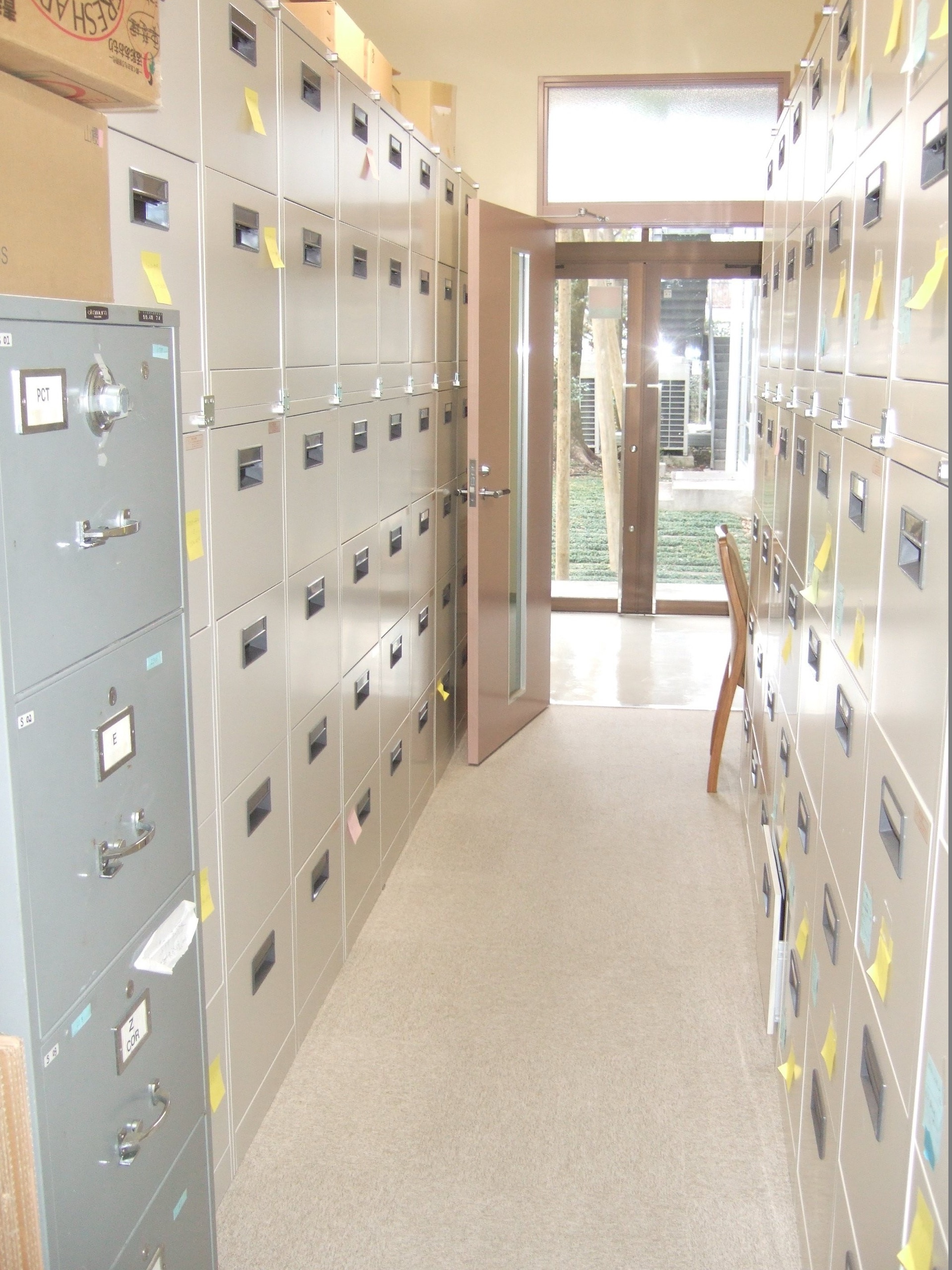
Documentary materials from the s, c, d, and e series, as listed in the “Complete List of YHAL Materials” published on the Yukawa Memorial Hall Archives (YHAL) website. This collection consists of approximately 44,000 items left behind by Hideki Yukawa in his laboratory at the Department of Physics, Faculty of Science, Kyoto University; his office as director of the Institute for Fundamental Physics; and his home.
Era
1920s–1980s
Designation as Cultural Properties, etc.
None in particular
Reasons for Certification
Hideki Yukawa was a theoretical physicist who won Japan’s first Nobel Prize (in Physics) in 1949. This collection is a large body of materials that not only documents the research process behind the theory of mesons—the work for which he received the Nobel Prize—but also chronicles the history of the development of Japan’s postwar academic research system, Yukawa’s approach to his social responsibilities as a scientist, and societal trends regarding nuclear power and nuclear issues.
Photographs
Image
Description
Explanation
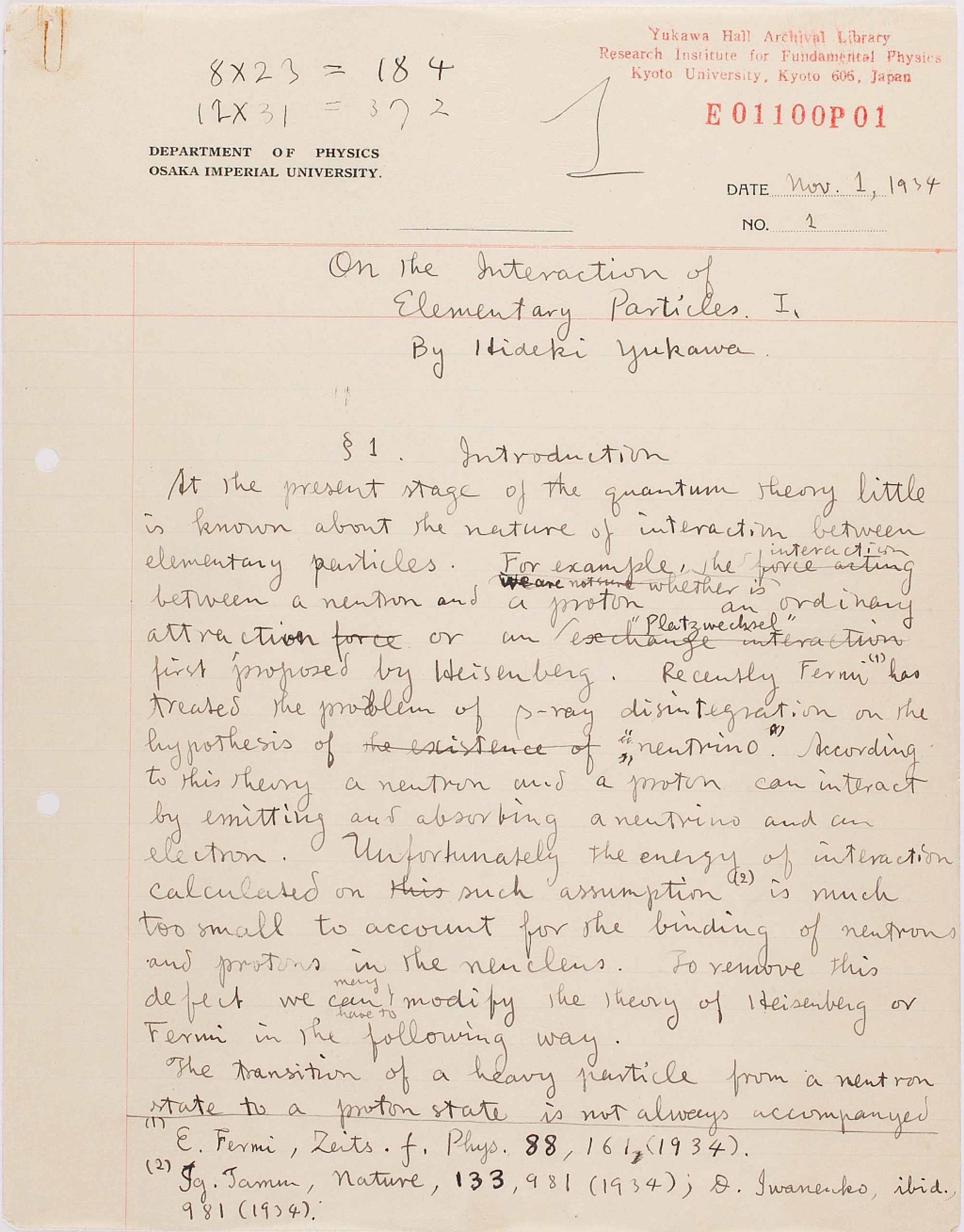
This collection of historical documents includes primary sources—rare even in the context of world history—that allow us to trace in detail the research process and the state of the academic world at the time, revealing how Japan’s first Nobel Prize-winning achievement was accomplished. Yukawa had organized and preserved detailed records of his research, including the process leading to the formulation of the meson theory, as well as calculation processes, notes, transcribed versions of related papers, manuscripts for academic conference presentations, and handwritten and typed drafts of his papers.While the detailed guidance provided by Shin’ichirō Tomonaga was crucial to the prediction of the meson’s mass based on experimental results of nuclear reactions, the detailed correspondence from Tomonaga has also been preserved. The collection even includes a manuscript of a paper on the interpretation of the muon meson that was not accepted for publication. Furthermore, approximately 150 items—including numerous research and lecture notes, as well as diaries—spanning from his student days to his later years have been preserved.
After spending five years in the United States, Yukawa returned to Japan in 1953 and served as the first director of the Institute for Basic Physics at Kyoto University—Japan’s first national shared-use research institute—until his retirement in 1970. He established a pioneering research environment where theoretical physicists from across universities organized their own study groups to facilitate the exchange of research ideas and collaborative research, thereby setting a precedent for national shared-use research institutes in many academic fields that followed.Nearly 7,000 of the historical documents in this collection, dating from the 1950s and 1960s, pertain to international conferences, study groups, institute management, shared use, and other matters related to the Institute for Fundamental Physics. These documents are not merely records of an individual’s achievements; they also constitute a valuable collection that illustrates the broader history of the development of Japan’s postwar academic research system.
The collection includes approximately 3,800 items, ranging from committee documents and minutes dating back to 1956—when Yukawa served as the first member of the Atomic Energy Commission—to related materials such as newspaper clippings on the peaceful use of nuclear energy.He also signed the Russell-Einstein Manifesto and, as a scientist, was actively involved until the end of his life in efforts to achieve the abolition of nuclear weapons and world peace through organizations such as the Pugwash Conferences, the Kyoto Conference of Scientists, the Seven-Person Committee for a World Peace Appeal, and the World Federalist Movement.The collection includes nearly 8,000 items related to these activities—such as various committee documents, statements, newspaper reports, materials from international conferences, and correspondence—which not only serve as a record of how Yukawa personally addressed the social responsibilities of a scientist but also constitute valuable historical materials documenting societal trends regarding nuclear energy and nuclear issues.
The collection, organization, and analysis of these historical materials began with the establishment of the Yukawa Memorial Hall Archives in August 1979. Shortly thereafter, on October 26, cardboard boxes were discovered that had been mistakenly moved from the former Yukawa Laboratory to the library of the Department of Physics at Kyoto University, where they had lain dormant in the stacks for many years.These were the materials that the young Yukawa had organized and preserved for each of his research papers—including calculations, lecture manuscripts, and drafts—but which had been lost. They were packed full of research content, beginning with his work on meson theory. These materials, along with the “Laboratory Diary” (1938–1948)—which had been discovered at the Department of Physics the previous year—were donated to the Archives by Yukawa himself.Furthermore, after Yukawa’s death, the Archives received a donation from his family of a large volume of physics-related materials that had been left at the Institute for Fundamental Research and at his home. There are also related historical materials donated by sources other than the Yukawa family, and these are widely utilized.
Location
Location
Public Access
Publication Status
Bibliographic data for all historical documents, as well as full-page scanned images of some of them, are available on the Historical Documents Room website (https://www2.yukawa.kyoto-u.ac.jp/~yhal.oj/archive.html). You may view the original documents in person upon submission of the required viewing request form and approval.